
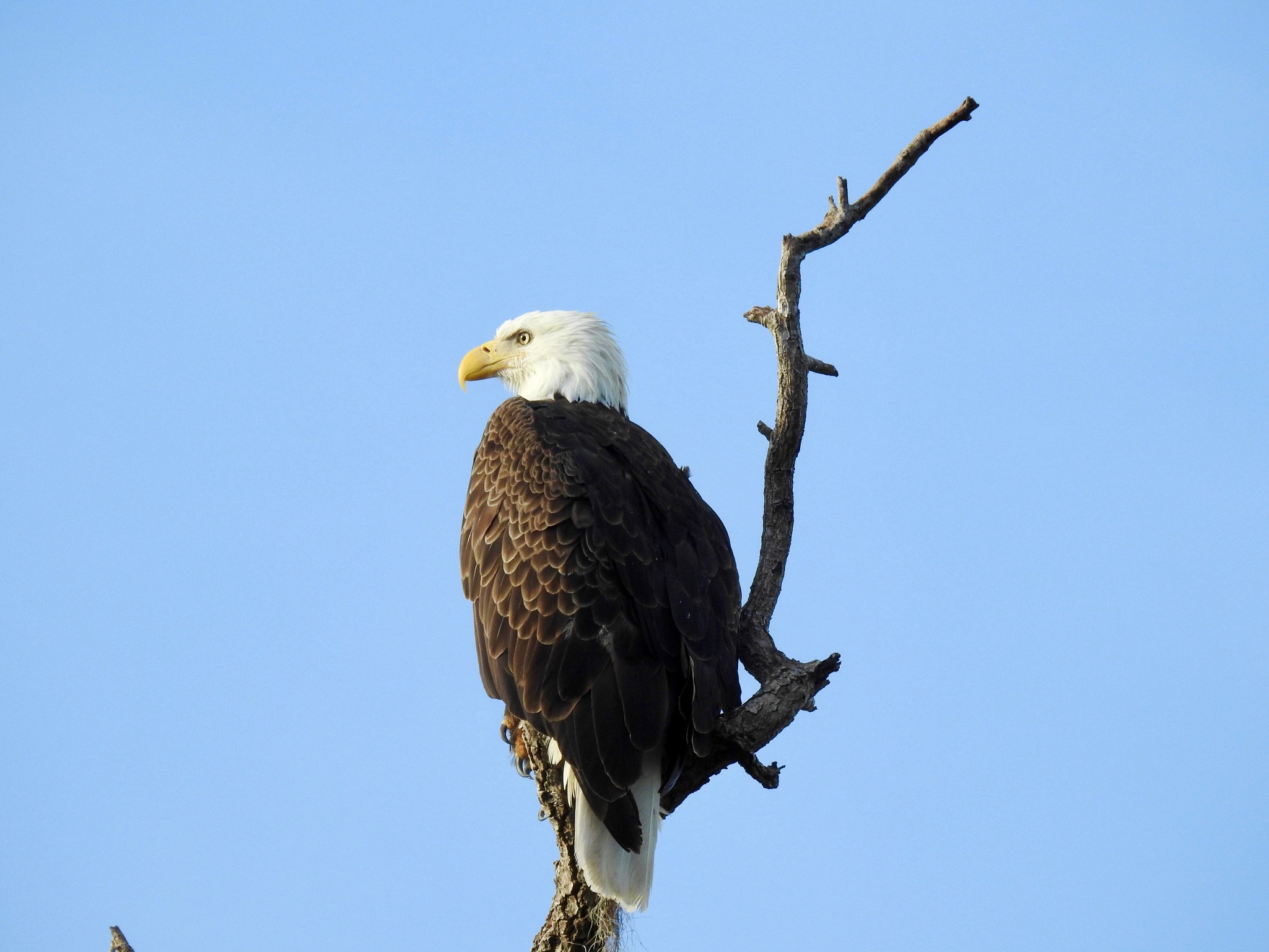
The word “bald” comes from an older word meaning white—the birds are fully feathered.
Field notes from the canopy
Fun Facts
Discover the remarkable adaptations, family lives, and conservation stories of Central Florida’s bald eagles and ospreys.
Scientific Name: Haliaeetus leucocephalus
Bald Eagle Facts

Powerful, adaptable, and unmistakable in adult plumage, the bald eagle is one of North America’s great conservation success stories.
A bald eagle’s broad wings can span about 6 to 7 feet and are built for efficient soaring.
Their exceptional vision helps them locate prey from great distances.
Fish are a dietary mainstay, but bald eagles also eat waterbirds, small mammals, and carrion.
Bald eagles sometimes pursue other birds and steal their freshly caught food.
Their hooked beak tears food while powerful feet and talons secure it.
Warm rising air called thermals lets eagles gain altitude while conserving energy.
Bald eagles can swim using a powerful rowing motion with their wings.
During courtship, a pair may lock talons and cartwheel dramatically through the air.
Pairs commonly remain together for life, although a surviving bird may choose another mate.
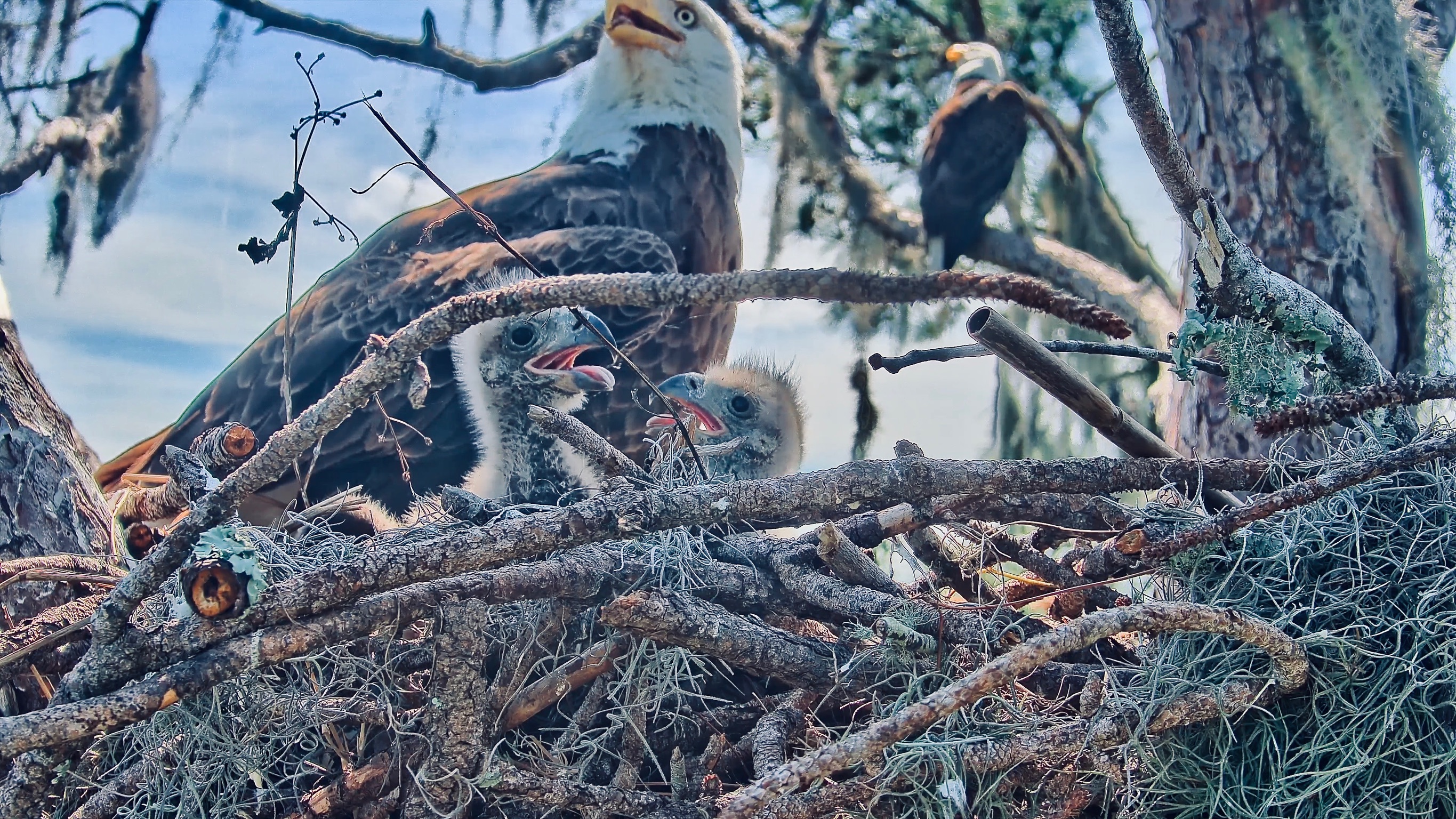
Both parents help incubate eggs and care for their young.
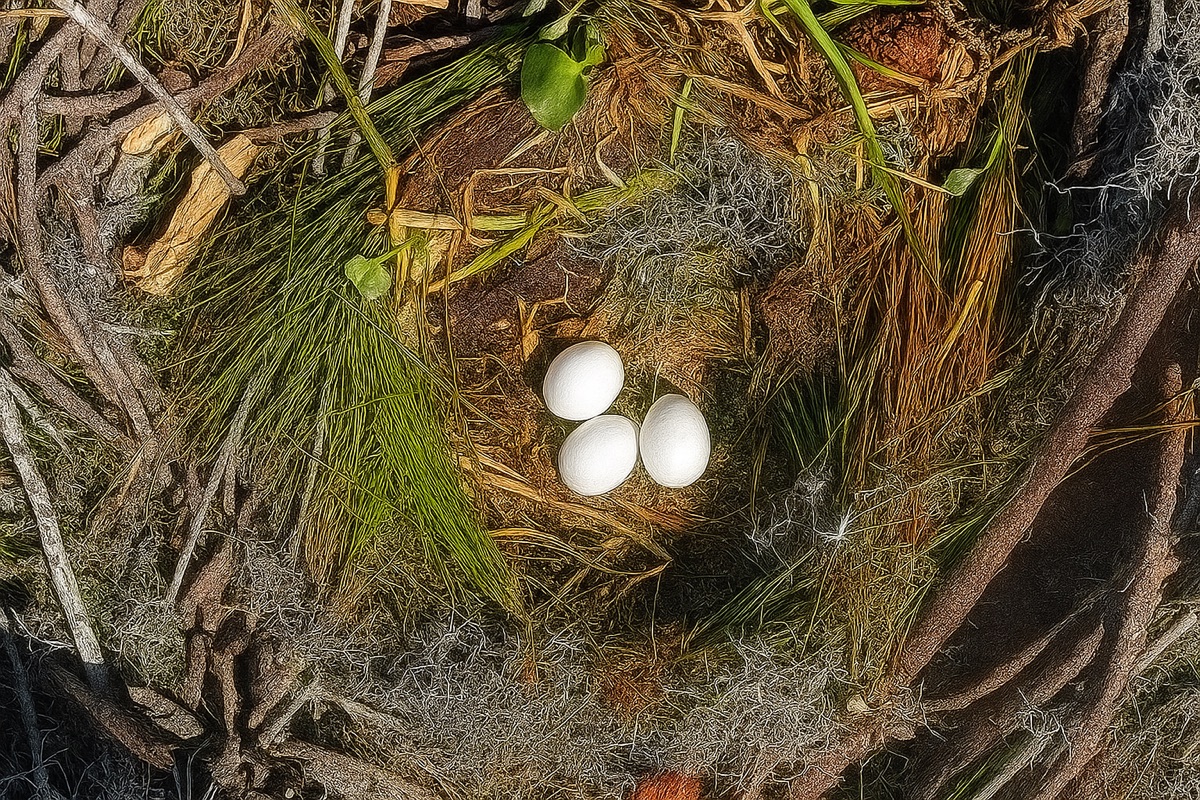
A typical clutch contains one to three dull-white eggs.
Newly hatched eaglets are covered in light-gray down.
Young eagles generally make their first flights about 10 to 12 weeks after hatching.
Juveniles are mottled brown and usually develop the familiar white head and tail at about five years old.
Pairs often return to and enlarge the same nest year after year.
Bald eagles construct some of the largest nests built by any bird.
The largest recorded bald eagle nest was in St. Petersburg, Florida: about 9.5 feet wide and 20 feet deep.
In Florida’s warm climate, bald eagle nesting activity occurs primarily during winter.
Bald eagles are native to North America and may live around 30 years in the wild.
The bald eagle became the national emblem of the United States in 1782.
The familiar movie “eagle scream” is often actually the call of a red-tailed hawk.
After severe declines linked to habitat loss, shooting, and DDT, bald eagles made a remarkable recovery.
They left the federal endangered-species list in 2007 but remain protected by federal law.
A Florida-sized record
The largest recorded bald eagle nest was found right here in Florida.
The St. Petersburg nest measured approximately 9.5 feet across, 20 feet deep, and weighed almost 6,000 pounds.
Scientific Name: Pandion haliaetus
Osprey Facts

Everything about an osprey—from its reversible toe to its closable nostrils—is beautifully adapted for life as an aerial angler.
Ospreys are fishing specialists—their diet consists almost entirely of fish.
Short, sharp spines called spicules cover the undersides of their toes and help grip slippery prey.
A reversible outer toe allows an osprey to hold a fish with two toes facing forward and two backward.
Special nostril valves close when an osprey plunges into the water.
Ospreys are among the few raptors that regularly dive completely underwater to catch prey.
They hover briefly above water before folding their wings and diving feet-first.
After a catch, an osprey usually turns the fish head-first to reduce drag in flight.
An osprey may make several dives before successfully catching a fish.
If a fish is too heavy, the bird may struggle along the surface and ultimately release it.
Bald eagles sometimes chase ospreys and steal their fish in mid-air.
Dense, oily plumage helps an osprey shed water after a dive.
Ospreys sometimes shake water from their feathers in mid-air, much like a wet dog.
Their long, narrow wings often form a shallow “M” in flight—a useful identification clue.
Adult ospreys have yellow eyes; juveniles usually have orange to reddish eyes.
Females are generally larger than males and often show a stronger necklace of brown markings.
Osprey chicks grow rapidly during their first weeks in the nest.
Young birds are nestlings before their first flight; leaving the nest is called fledging.
Pairs often reuse the same nest and add sticks each season.
Long-used osprey nests can grow several feet wide and deep.
Ospreys readily nest on platforms, channel markers, utility structures, and other elevated sites.
They occur on every continent except Antarctica.
Many northern ospreys migrate thousands of miles between North and South America.
Florida supports both year-round resident ospreys and seasonal migrants.
Central Florida’s lakes, rivers, wetlands, and the St. Johns River basin provide outstanding osprey habitat.
Keep exploring